Latest Edition of the Tax Newsletter
The more you make, the more they take.
- My USPS worker
Hello former 15.518ers (plus):
I hope you all have had a great summer.
Today I am discussing which tax rate should be used in making decisions and evaluating tax benefits – marginal rate, effective rate, statutory rate, etc. I have done a lot of work on this type of analysis in my research and it is in my co-authored tax textbook that we (theoretically) used for class. (Remember, none of this is tax or investment advice.)
The marginal tax rate is the rate that applies to your next dollar of income. This is the rate that should be used when evaluating alternative investment decisions or almost any decision because that is the rate that will apply to the incremental income from that decision. In contrast, the effective tax rate is your average tax rate – the average tax burden per dollar of income. This is not helpful in making most incremental decisions because it is not necessarily the rate that will apply to a particular transaction but instead the average rate that resulted from all the transactions you have taken in the year.
Now back to the quote above. Our mail lady loves dogs so she always stops to see our dog and give her treats. One time this summer while she was stopped, we started talking and she was telling me she was working so much overtime because some others were not coming in for their shift. I asked her if she got extra pay for that. In a very animated manner she answered “Yes, but the more you make, the more they take.” So…she didn’t seem too interested in working much extra. I Googled how much an average USPS delivery person makes and it is around $30/hour. Let’s say she makes $40/hour here near Boston, her marginal rate taking the U.S., MA, and payroll taxes into account is probably around 34.6%. Indeed, the closest Federal tax bracket she crossed went from a top tax rate of 12% to a rate of 22%, so her reasoning is likely sound based on what she observes – they are taking a lot more! She would likely get an additional deduction of $12,500 from the recent ‘no tax on overtime’ provisions which would make her federal marginal rate equal to zero on the first additional $12,500. However, she would still owe MA taxes and payroll taxes even on those earnings. And once she earns past the $12,500, the extra earnings are fully taxable and her marginal rate is 34.6%. How much taxes affect labor supply is a long-standing question. Hopefully, I’ll have more to say on that issue next year. For now, even when just talking to my mailperson for 10 minutes, taxes comes up – seems like almost everything comes back to taxes!
Speaking of tax rates, municipal bonds are gaining popularity lately. (See these headlines here and here, I think you need a subscription to read though. Here is a WSJ. ). This is especially true in high-tax states like MA (and NY and CA). Let me first give some background on muni bonds.
Municipal bonds are bonds issued by a state, city, county, or local government agency. The proceeds are usually used to pay for some public good. If you invest in muni bonds issued in MA and you are a MA tax resident (change the state in both places in that sentence for your residence), the interest income from the bonds is tax free to you at both the federal and the state level. However, the pre-tax rate of return is lower. In this sense the federal government is subsidizing issuers of muni bonds – the issuer can offer a lower interest rate because investors know the interest is tax free. At a high level, investors in the high tax bracket are often better off with munis but investors in the lower tax brackets should not invest in munis (for tax reasons). We discussed this in class to some degree (for some of you, we covered this by talking about Teresa Heinz Kerry’s investments as they were covered in the WSJ). If you recall, the difference between the market rate of interest on a taxable corporate bond and the market rate of interest on a muni bond with similar risk is called an implicit tax: it’s the amount the investor is willing to give up in pre-tax rate of return to get tax-free interest. You can find calculators such as the one here that help people determine what is better in their situation.
MA put in a millionaire’s tax starting in 2023. Now, in 2026 if your taxable income is above $1,107,750 (whether you are single or married filing jointly) you are subject to a 4% surcharge on income over the threshold making the top marginal rate 9%.
Once you are in the MA millionaire tax bracket your marginal tax rate on taxable interest income is getting up there… federal tax (37%) + federal net investment income tax (3.8%) + state tax (in MA with the surcharge would be 9%) which is 49.8%. At that point you might be thinking like my mail person! Muni bonds are one way people lower their tax bill a bit. Remember, the pre-tax rate of return on a muni is lower, so you are not benefiting by 49.8%, but for investors in the top bracket there is a benefit (holding risk levels of the bonds constant).
Finally, let’s consider a business. The marginal tax rate is again the correct tax rate management should use when making decisions; deciding to borrow money (e.g., should the company issue debt or equity?), make an investment, structure compensation a certain way, etc. The effective tax rate would not be the right rate to use because, again, the effective rate is an average rate and would not be informative about the value of any specific deduction.
I wrote a paper on the use of different tax rates and the effects on corporate capital structure and investment decisions some years ago. You can read that here if you are interested.
The National Debt
You may recall that in class I spent the first week talking about the tax system, government spending, etc. You probably heard in the news this past week that we crossed $40T in national debt. The WSJ covered it here and below is a graph from the article.
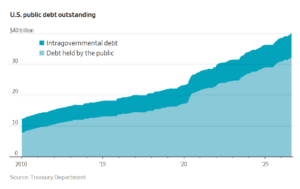
It’s not only the level, but the slope that is very concerning. Especially in light of the fact that there does not seem to be a solution in sight. This path is not sustainable.
As you can imagine, with debt levels this high, the interest cost is getting problematic. The Congressional Budget Office projects that net interest costs on the U.S. national debt will reach approximately $1.04 trillion for fiscal year 2026. This amounts to roughly 3.2% to 3.3% of GDP and consumes about 18% to 19% of all federal tax receipts. This is roughly on par with our spending on defense. If interest rates rise the interest will take even more of our budget and leave less for other uses.
Sorry to end on a sour note! Hopefully, I will get to Edition 9 more quickly!
Michelle